

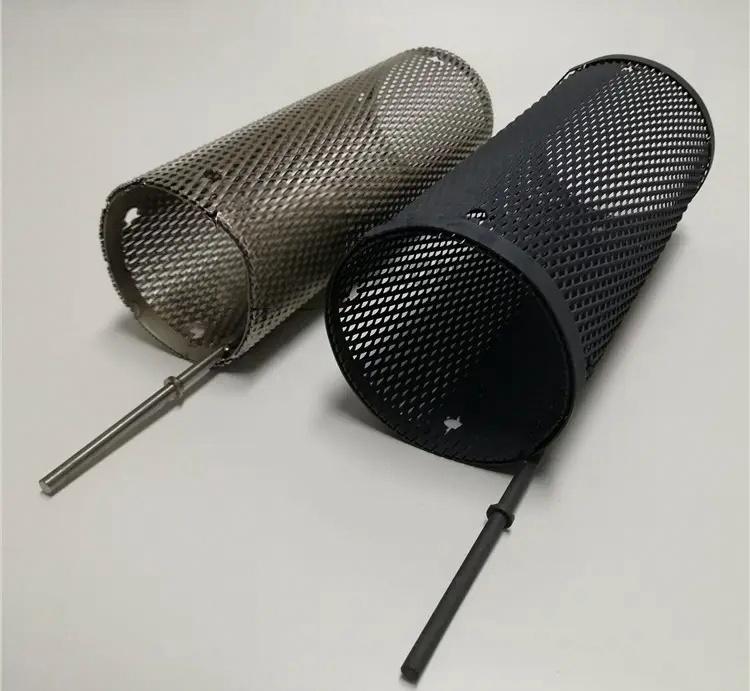
Titanium Electrode Applications: Where Ruthenium-Iridium and Noble Metal Oxide Coated Titanium Anodes Actually Work
A titanium electrode is a titanium substrate — TA1/TA2 under GB/T 3620.1, or Grade 1/Grade 2 under ASTM B338 — carrying a noble metal oxide coating applied in multiple thermal decomposition passes. The coating, not the titanium, determines the reaction: ruthenium-iridium (RuO₂-IrO₂) coatings are chosen where chlorine evolves, iridium-tantalum (IrO₂-Ta₂O₅) coatings where oxygen evolves, lead dioxide where a cheap high-oxygen-overpotential surface is acceptable, and platinum where chemical inertness matters more than current density. Getting that match wrong is the single most common cause of a coated titanium anode failing inside two years.
This article maps the five application families that dominate industrial demand — chlor-alkali and electrochlorination, wastewater treatment, non-ferrous electrowinning, electroplating, and impressed current cathodic protection — plus the small-cell disinfection market, and shows which coating, shape and current density each one requires.
Key facts at a glance
| Parameter | Typical value |
|---|---|
| Substrate | TA1/TA2 (GB/T 3620.1) ≡ Grade 1/Grade 2 (ASTM B338) |
| Coating loading | 8–20 g/m² noble metal, applied over 10–30 passes |
| Chlorine-evolution coating | RuO₂-IrO₂-TiO₂, up to several kA/m² in brine |
| Oxygen-evolution coating | IrO₂-Ta₂O₅, 200–500 A/m² in acid sulfate |
| Wastewater anode sizing | 100–300 A/m² (by-product limited, not coating limited) |
| ICCP current density | 50 A/m² (backfill) → 600 A/m² (seawater) |
| Life scaling law | L₂ = L₁ × (i₁ ÷ i₂) — charge-limited, not calendar-limited |
| Life verification | NACE TM0108 accelerated test (soils and natural waters) |
Why a titanium electrode is not a titanium product
The substrate exists to be inert. Titanium passivates instantly in air and water, forming a TiO₂ film a few nanometres thick that survives the life of the anode. That film is also why bare titanium cannot be used as an anode: it is a dielectric, and current cannot pass. The noble metal oxide coating is what converts an insulator into an electrocatalyst.
This is the practical reason to check a supplier's core business before checking its price list. A fabricator that bends, welds and machines titanium can produce a geometrically perfect anode with a coating that was fired at the wrong temperature, applied in too few passes, or formulated for the wrong reaction. Coated titanium anodes belong to electrochemistry, not to metalworking — the specification that matters is coating loading and accelerated-test life, not plate thickness alone.
For the definitional background — substrate preparation, coating chemistry, and how an MMO anode differs from a sacrificial one — see the complete guide to coated titanium electrodes.
The selection rule: match the coating to the gas being evolved
Every application below reduces to one question — is chlorine or oxygen the dominant anodic product? — because that single fact decides which oxide survives.
| Coating | Reaction it is built for | Operates best in | Fails when |
|---|---|---|---|
| RuO₂-IrO₂-TiO₂ | Cl₂ evolution | Brine, seawater, chloride-bearing effluent, hypochlorite cells | Exposed to oxygen evolution at high potential; chloride-free duty |
| IrO₂-Ta₂O₅ | O₂ evolution | Acid sulfate/chloride electrolytes, soil, fresh water | High fluoride; frequent current reversal beyond design |
| PbO₂ | O₂ evolution | Sulfuric acid, some organic oxidation | Product purity or effluent lead limits apply |
| Pt / Pt on Ti, Nb, Ta | Either, at low current density | Precious-metal plating, ionizer cells, hard chrome | Current density pushed too high; platinum dissolves |
Two consequences are worth stating plainly, because they are where most specification errors originate:
Ruthenium is a chlorine catalyst, not a general-purpose catalyst. RuO₂ has the lowest chlorine overpotential of any practical oxide, which is why it dominates chlor-alkali. Under oxygen evolution it corrodes quickly. Specifying Ru-Ir "because it is the standard coating" in a chloride-free wastewater cell is a design error that surfaces 12–24 months later as coating loss.
Iridium is slower but far more durable under oxygen. IrO₂-Ta₂O₅ costs more per square metre and carries a higher oxygen overpotential, and it is the only sensible choice in acidic electrowinning, soil groundbeds and low-chloride oxidation.
Application 1: Chlor-alkali and on-site electrochlorination
This is where the technology began. Ruthenium-oxide coated titanium anodes replaced graphite in chlor-alkali cells in the 1960s and 1970s, cutting cell voltage and eliminating the graphite sludge that contaminated the product. The dimensionally stable anode concept — a substrate that never changes dimension while a coating does the work — has shaped every electrochemical cell designed since.
Modern duties split into three current-density regimes:
- Chlor-alkali membrane cells: several kA/m² at 80–90 °C, with brine purified to ppb hardness. Coating durability, not kinetics, sets the replacement interval. See Ru-Ir coated anodes for the chlor-alkali industry.
- Seawater electrochlorination: 1–3 kA/m² on plate or tubular electrodes, generating hypochlorite for cooling water, ballast water and offshore facilities. The failure mode here is scale, not coating loss — hardness and magnesium precipitate on the cathode side and must be removed by acid wash or polarity reversal. See titanium electrodes for seawater electrochlorination.
- Brine anti-fouling and small hypochlorite generators: lower current density, longer coating life, and the same Ru-Ir chemistry scaled down.
In all three, the anode is a consumable measured in ampere-years. Coating loading is the purchase decision; current density is the life decision.
Application 2: Electrochemical treatment of industrial wastewater
Ru-Ir wins here for one reason: chloride. Where the effluent contains chloride, the anode generates available chlorine, and that oxidant does most of the COD and ammonia removal indirectly — at a fraction of the energy cost of direct anodic oxidation.
The four target pollutants behave differently, and it is worth separating them because suppliers often quote one removal rate for all four:
| Pollutant | Mechanism | Coating implication |
|---|---|---|
| COD / TOC | Indirect oxidation by available chlorine; direct oxidation at high potential | Ru-Ir above ~500 mg/L Cl⁻; Ir-Ta or BDD below |
| Ammonia nitrogen | Breakpoint chlorination at the anode | Ru-Ir, sized 100–300 A/m² |
| Total nitrogen | Requires a cathodic reduction stage for nitrate | Anode choice matters less than cell design |
| Nitrate / nitrite | Cathodic reduction — not an anodic reaction | Anode's role is to hold cell voltage and limit chlorate |
That last row is the most frequently misunderstood. Nitrate is not destroyed at the anode; it is reduced at the cathode. A cell sold as "nitrate removal by MMO anode" is really a cathode-driven process, and the anode specification should be judged on chlorate formation and energy consumption instead.
Two design constraints follow. First, chloride threshold: below roughly 500 mg/L, indirect oxidation slows sharply and a different anode family (Ir-Ta, or boron-doped diamond for refractory COD) gives better cost per kilogram of COD removed. Second, by-products: chlorate and AOX rise with current density and chloride concentration, so full-scale cells are sized at 100–300 A/m² rather than at the coating's maximum — the limit is regulatory, not electrochemical.
Relevant product families: electrochemical oxidation electrodes, MMO anodes for ammonia removal, landfill leachate treatment anodes, and lead dioxide coated anodes where lead is acceptable and high oxygen overpotential is required.
Application 3: Electrowinning and electrodeposition of non-ferrous metals
This is the harshest duty in the family: hot acid, continuous oxygen evolution, and currents in the hundreds of amps per square metre. It is also where coated titanium anodes have the clearest economic case, because the alternative — lead alloy — contaminates the product.
Requirements for an electrowinning anode are usually listed as corrosion resistance, dimensional stability, long service life and good electrocatalysis. The last one is the one that pays: lower anode potential means lower cell voltage, and cell voltage multiplied by current is the plant's largest operating cost.
Life arithmetic, and why the same anode is quoted at 5 years in one plant and 50 in another. Anode life is charge-limited, not calendar-limited:
L₂ = L₁ × (i₁ ÷ i₂) where L is service life in years and i is anode current density in A/m².
Halve the current density and the coating carries the same total charge over twice the time — provided the coating stays bonded and the substrate does not hydride. This is why an ICCP groundbed designed at 200 A/m² and a zinc cell running at 450 A/m² cannot share a life figure, and why any "design life" claim must be read together with the current density it assumes.
At a zinc cell voltage of about 3.3 V, a 100 mV reduction in anode potential cuts roughly 80 kWh per tonne of cathode against a power demand near 2,700 kWh/t — about 3%. On a 100,000 t/y circuit that is the entire coating budget, several times over.
Coating selection by metal:
- Zinc (H₂SO₄, 35–40 °C, 400–500 A/m²): IrO₂-Ta₂O₅, with a manganese-tolerant formulation where Mn is present. See MMO anodes for zinc electrowinning cells.
- Copper (H₂SO₄ with chloride, 250–350 A/m²): Ir-Ta plate, because chloride accelerates ruthenium loss. See Ir-Ta anode plates for copper electrowinning.
- Nickel (chloride-bearing electrolyte, 200–400 A/m²): the hardest case, because chlorine and oxygen evolve together. The workable answer is a layered electrode — a platinum flash on titanium or tantalum to resist chlorine attack at the substrate, with an IrO₂ catalyst on top — and strict avoidance of cathodic excursions, which strip the coating quickly. See iridium oxide anodes for nickel electrowinning.
- Cobalt: titanium plate anodes with Ir-Ta coating, sized for acid mist capture as much as for current. See titanium plate anodes for cobalt electrowinning.
Application 4: Electroplating and PCB copper plating
The value here is bath stability, not speed. An insoluble coated titanium anode does not dissolve, so metal concentration is controlled by the cathode and by additions alone — no anode sludge, no bag changes, no continuous filtration.
That matters most where the metal is expensive. In gold and rhodium plating, sludge is lost metal at the highest cost per kilogram in the plant. In PCB copper plating, a dimensionally stable anode holds the anode-to-cathode gap constant across a panel, which is what makes thickness distribution predictable on high-aspect-ratio boards.
Coating selection in plating follows the bath chemistry rather than the metal:
- Acid copper and cyanide-free alkaline copper: Ir-Ta or Ru-Ir mesh, sized for uniform current distribution. See MMO coated anodes for electroplating and anodes for PCB copper plating.
- Trivalent chromium: IrO₂ is the mainstream choice. See iridium oxide anodes for chromium plating.
- Hexavalent (hard) chromium: chromic acid plus fluoride attacks most oxide coatings, so platinized titanium is used instead — it also eliminates the lead sludge that makes hard chrome a hazardous-waste problem. See platinized titanium anodes for hard chrome plating.
One caution that belongs in every plating RFQ: fluoride is a coating poison. Baths containing fluoride — some chrome and tin formulations, and HF-bearing pre-treatment — shorten Ir-Ta life dramatically. If fluoride is present, say so; the coating and the loading change.
Application 5: Impressed current cathodic protection
The anode is the component that must not fail, because replacing a deep well means excavation and replacing a hull anode means dry-docking. Everything else in an ICCP system — transformer rectifier, reference electrodes, junction box — is accessible; the anode is not.
Coated titanium anodes operate in seawater, fresh water, soil, coke breeze and desert groundbeds, but the permissible current density changes by an order of magnitude:
| Environment | Maximum current density | Practical design range |
|---|---|---|
| Carbonaceous backfill | 50 A/m² | 20–40 A/m² |
| Calcined petroleum coke breeze | 100 A/m² | 40–70 A/m² |
| Fresh water | 100 A/m² | 40–70 A/m² |
| Brackish water | 300 A/m² | 100–200 A/m² |
| Seawater | 600 A/m² | 200–400 A/m² |
On the 50–70 year figure. AUE's ICCP designs reach design lives of 50–70 years, and the arithmetic behind that is the life-scaling law above rather than a special coating: a coating rated 20 years at 600 A/m² carries the same charge in roughly 60 years at 200 A/m². The claim holds only where three conditions are met — the groundbed is sized at 150–250 A/m² in coke breeze, the coating loading is scaled to the total charge rather than to a catalogue number, and the cable joint is sealed against moisture. Anode failure in the field is more often a joint failure than a coating failure. Verification is by accelerated test to NACE TM0108, which is the standard for catalyzed titanium anodes in soils and natural waters.
Shape follows the structure, and the range is broader than most buyers expect:
- Deep vertical groundbeds: MMO tubular anodes and cylindrical deep well anode assemblies in a coke breeze column
- Tank bottoms and buried structures: MMO ribbon anode and flexible linear anode, which distributes current evenly and tolerates settling
- Ship hulls and offshore structures: MMO disk anodes flush-mounted through the shell
- Small structures and short beds: wire and probe anodes, sized on current demand rather than area
The system view — rectifier, anode bed, reference electrode and current distribution — is available as a complete ICCP titanium anode package, and the comparison against graphite, lead-silver and platinum anodes is in the MMO vs traditional anode selection guide.
Application 6: Electrolytic disinfection and small-cell electrodes
Here the constraint is by-product control and scale, not current density. Iridium-oxide and platinum-coated titanium electrodes drive the small electrolytic cells inside:
- Water ionizers and alkaline/acidic water generators — platinized titanium plates, where the requirement is years of intermittent operation without coating loss
- Hydrogen-rich water appliances and cups
- Disinfection washing machines, fruit-and-vegetable washers and portable sanitizers, where the electrode produces available chlorine from tap water chloride
These cells run at low current and low conductivity, so durability is rarely the limiting factor. The real design limits are chlorate and bromate formation — which is why appliance controllers build in polarity reversal or periodic descaling, and why potable-water devices need certification against local by-product limits rather than a materials certificate alone.
What to put in an RFQ for a coated titanium anode
Six items separate a comparable quote from an incomparable one. Ask for all six before comparing price per square metre:
- Coating loading, in g/m² of noble metal — not "thick coating" or "3 coats"
- Accelerated life test result to NACE TM0108 or the ISO 19097 method, at your operating current density
- Substrate certification to ASTM B338 Grade 1 or 2, with mill test report
- Coating type matched in writing to your electrolyte — chlorine evolution or oxygen evolution, and the chloride and fluoride levels it was selected against
- Rated current at your environment from the current-density table, not the coating's survival maximum
- Joint and seal design for submerged or buried service, including cable type and encapsulation
Xi'an AUE Technology manufactures coated titanium anodes — Ru-Ir, Ir-Ta, platinized and lead dioxide — on ASTM B338 substrates, with coating performance confirmed by accelerated testing. The ISO 9001 quality management system and production lines are described in the company profile, and the FAQ page covers ordering, lead time and export documentation.
Frequently asked questions
What is the difference between a ruthenium-iridium and an iridium-tantalum coated titanium anode? Ru-Ir is optimized for chlorine evolution: lowest chlorine overpotential, highest current density, best performance in brine, seawater and chloride-bearing effluent. Ir-Ta is optimized for oxygen evolution: higher overpotential but far greater durability in acid sulfate, soil and fresh water. Ru-Ir fails quickly under oxygen evolution; Ir-Ta is the wrong economics where chlorine is the product.
Can one coating handle both chlorine and oxygen evolution? Not well. Where both gases evolve — nickel electrowinning in chloride electrolyte is the classic case — the workable design is layered: a platinum flash on the titanium or tantalum substrate to resist chlorine attack, with an IrO₂ catalyst on top. Single-layer coatings lose one component preferentially and fail early.
Why are lead anodes still used in copper electrowinning, and when should they be replaced? Lead alloys are cheap and mechanically robust, but they dissolve slowly and co-deposit lead into the cathode, and the resulting sludge is a hazardous waste. Coated titanium anodes are justified where cathode purity, sludge disposal cost or acid mist control dominates the purchase decision.
How is a 50–70 year anode life calculated and verified? Calculated from charge: life scales inversely with current density (L₂ = L₁ × i₁/i₂), so a coating rated 20 years at 600 A/m² reaches roughly 60 years at 200 A/m². Verified by accelerated life testing to NACE TM0108 at the design current density — a life claim without a test current density attached is not verifiable.
What current density should I specify for ammonia removal? 100–300 A/m² in most chloride-bearing effluents. Above that, chlorate and AOX formation rise faster than ammonia removal, and the operating cost penalty outweighs the smaller anode area.
Does fluoride damage MMO coatings? Yes, severely. Fluoride attacks the titanium oxide interface and accelerates coating disbondment, particularly under Ir-Ta. Fluoride-bearing baths and pre-treatment streams need a different coating strategy and should be declared in the RFQ.
Which anode shape is right for a buried pipeline versus a storage tank? Ribbon or flexible linear anodes for tanks, tank bottoms and congested piping where current must be distributed over an area; tubular or cylindrical canister anodes in vertical deep wells where current is injected from a point; disk anodes for hulls. Shape follows current distribution, not preference.
References and standards
- ASTM B338 — Standard Specification for Seamless and Welded Titanium and Titanium Alloy Tubes for Condensers and Heat Exchangers (Grade 1 and Grade 2 substrate)
- NACE TM0108 — Testing of Catalyzed Titanium Anodes for Use in Soils or Natural Waters
- ISO 19097 series — Accelerated life test method of mixed metal oxide anodes for cathodic protection
- NACE SP0169 / AMPP — Control of External Corrosion on Underground or Submerged Metallic Piping Systems
- GB/T 3620.1 — Chinese designation system for titanium and titanium alloy grades (TA1, TA2)