

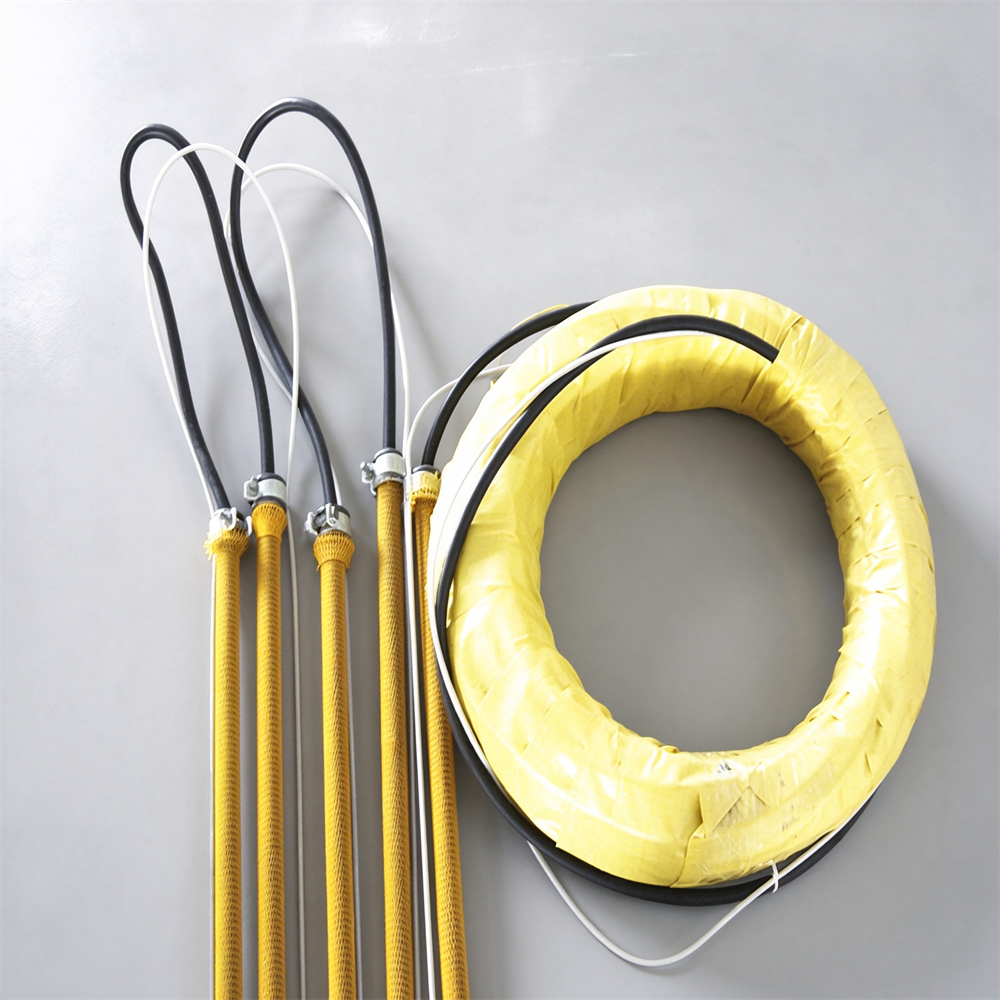
MMO Coated Tubular Anode Strings for Impressed Current Cathodic Protection
An MMO coated tubular anode string is a permanent impressed-current anode assembly: titanium tubes coated with a mixed metal oxide, spliced onto a single header cable, installed as one unit — in a coke-breeze column in a deep well, free in seawater, or embedded in concrete. The tube carries the catalyst; the string decides whether the current actually reaches the structure. Most field failures blamed on "the coating" are string failures: a splice that took in water, a backfill that dried out, or an anode driven past its rated current density.
That distinction is why this page is about assemblies rather than tubes. A coated tube is a component with a current rating and a consumption rate. A string is a system with a resistance to earth, a cable voltage drop, a gas path and an installation procedure — and every one of those can waste the anode's capability before the coating becomes a factor.
Key facts
- Anode: titanium tube, Gr1 or Gr2, coated with IrO₂–Ta₂O₅ for soil and groundwater, or a RuO₂-based oxide for seawater and chloride duty.
- Wiring: anodes on a string are connected in parallel to one header cable, not in series; the header carries total current at the rectifier voltage.
- Coating loading: quoted in g/m². At a consumption rate near 0.1 mg/(A·h), each 1 g/m² of loading buys roughly 10,000 A·h/m² of charge.
- Life arithmetic: 20 g/m² at 1 A/m² gives about 23 years; doubling current density halves it.
- Groundbed resistance: R = ρ/(2πL)·[ln(4L/a) − 1] for a vertical anode in soil — a 3 m × 50 mm anode in 50 Ω·m soil is roughly 12 Ω before backfill.
- Backfill: coke breeze is not optional in soil; it lowers contact resistance, holds moisture and spreads consumption along the tube.
- Environment drives the design: soil wants low current density and backfill, seawater wants high current density and none, concrete wants very low current density and a disk or ribbon geometry.
On this page
- Why impressed current, and why tubular
- What a string actually contains
- Coating: Ir–Ta for soil, Ru for seawater
- Three calculations that size a string
- Installation: the part that decides the outcome
- Where these strings are used
- Failure modes worth designing out
- Specifying a tubular anode string
- FAQ
Why impressed current, and why tubular
A sacrificial system is sized by the driving potential between metals — a fixed budget of a few hundred millivolts. An impressed current system replaces that budget with a rectifier, so the anode can be small, the structure can be large, and the current can be turned up or down as coating degrades over the decades.
The tubular shape is what makes that practical. A tube gives high coated area per unit of borehole or structure volume, a stiff body that survives installation, a sealed envelope that keeps water away from the connection, and a geometry that can be pushed into a borehole, bolted to a jacket leg or cast into concrete.
| Property | MMO tubular string | Graphite anode | High-silicon cast iron | Galvanic (Zn/Al) |
|---|---|---|---|---|
| Current source | Rectifier (controllable) | Rectifier | Rectifier | Self-driven |
| Consumption rate | Very low | High, and it spalls | Moderate to high | Consumed by design |
| Current density in soil | Moderate and stable | Low | Moderate | Very low |
| Failure mode | Coating wear, splice ingress | Cracking, necking at the connection | Embrittlement, graphitisation | Depletion |
| Weight and handling | Light | Heavy and brittle | Heavy | Moderate |
| Typical duty | Long-life ICCP, deep wells, seawater | Legacy groundbeds | Legacy groundbeds | Small isolated structures |
What a string actually contains
- Coated tubes. One or more tubes on a single cable, each sealed at both ends. Diameter and wall thickness are chosen for mechanical survival and for the coated area the current requires.
- Coating. Sintered mixed metal oxide applied in multiple passes; loading and composition are the two specification numbers that matter.
- End caps and seals. Welded or swaged closed ends, with the cable entry sealed and encapsulated. This joint decides whether the anode survives in wet soil.
- Header cable. Sized for total string current and run length; its voltage drop is part of the rectifier budget and is frequently underestimated on long runs.
- Weight and centraliser. Holds the string at the intended depth and stops it resting against the casing.
- Backfill or canister. Coke breeze in a deep well or surface bed, a prepacked canister where a controlled environment is needed, nothing at all in seawater.
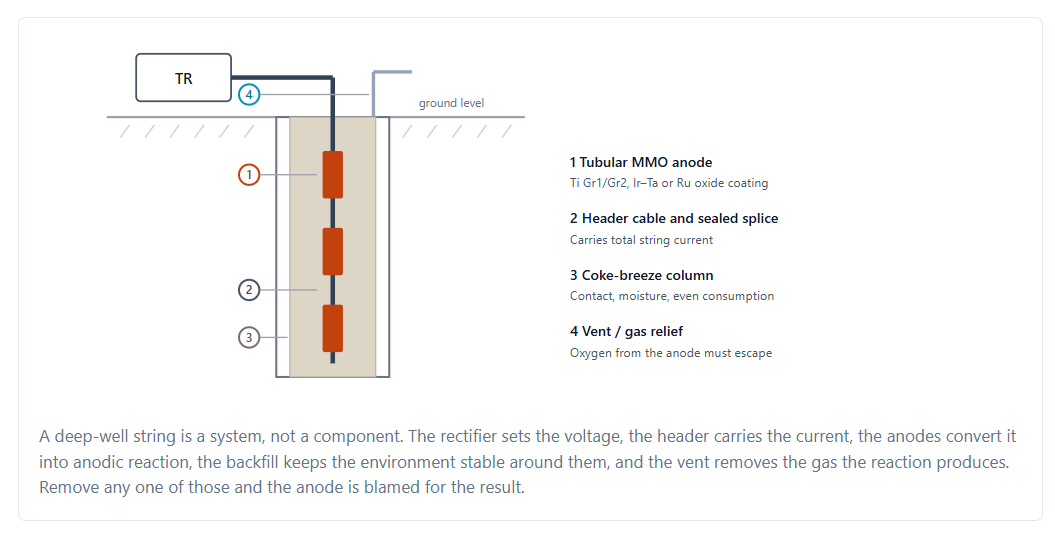
- A deep-well string is a system, not a component. The rectifier sets the voltage, the header carries the current, the anodes convert it into anodic reaction, the backfill keeps the environment stable around them, and the vent removes the gas the reaction produces. Remove any one of those and the anode is blamed for the result.
Coating: Ir–Ta for soil, Ru for seawater
The coating follows the reaction the environment produces.
| Environment | Dominant anode reaction | Coating | Why |
|---|---|---|---|
| Soil, groundwater, fresh water | Oxygen evolution | IrO₂–Ta₂O₅ | Iridium is stable at high anodic potential; tantalum holds the oxide network together |
| Seawater, brackish water, chlorinated systems | Chlorine evolution | RuO₂-based, often with Ir | Ruthenium has the lowest chlorine overpotential available |
| Concrete, buried rebar | Oxygen evolution at low current | IrO₂-based | Very low current density, very long life; geometry usually disk or ribbon |
| Mixed chloride and sulphate | Depends on the ratio | Blended Ru–Ir | Compromise: chlorine kinetics with iridium stability |
A coating described only as "Ir + Ta + Ru mixed oxide" is not a specification, because the ratio decides behaviour. A ruthenium-rich oxide in an oxygen-evolving borehole dissolves faster than it should — ruthenium can leave as volatile RuO₄ at high anodic potential — while an iridium-rich oxide in seawater gives up current efficiency for no benefit. Ask for the composition ratio and the loading, not the ingredient list.
Loading is the life number. Consumption is a surface phenomenon, so time to failure scales with grams per square metre and inversely with current density. The coating life calculation applies unchanged to a string; what a string changes is that current density is not uniform along its length.
Three calculations that size a string
1. Anode-to-earth resistance. For a single vertical anode in homogeneous soil, the Dwight expression is the standard first estimate:
R = ρ / (2πL) × [ln(4L/a) − 1]

ρ = soil resistivity (Ω·m)
L = anode length (m)
a = anode diameter (m)
A 3 m long, 50 mm diameter anode in 50 Ω·m soil:
R = 50 / (2π × 3) × [ln(4 × 3 / 0.05) − 1]
  = 2.653 × [ln 240 − 1]
  = 2.653 × 4.481 ≈ 11.9 Ω
That is the resistance before backfill. A coke-breeze column lowers it in two ways: it presents a larger effective diameter to the soil, and it replaces high-resistivity soil next to the anode with a low-resistivity, moisture-retaining medium. It is also why a dried-out groundbed loses output — column resistivity rises and the resistance follows.
2. Current demand against current output. Demand is set by the structure:
I_demand = protected area × design current density

5,000 m² × 10 mA/m² = 50 A
The number of strings then follows from allowable current per anode and the required redundancy. If one string is rated 15 A, three strings cover 50 A with one spare — the usual arrangement where a bed must keep working while a string is isolated for testing.
3. Coating life. With loading w (g/m²) and consumption rate r (mg/(A·h)):
life (h) = w × 1,000 / (r × i)

w = 20 g/m², r = 0.1 mg/(A·h), i = 1 A/m²:
life = 20 × 1,000 / (0.1 × 1) = 200,000 h ≈ 23 years
Two consequences follow, and they are the two levers a buyer controls. Loading buys life linearly: 30 g/m² instead of 20 gives about 34 years at the same current density. Current density buys or destroys it inversely: the same anode at 2 A/m² lasts about 11 years. A generously sized string is not over-specified — it is the cheapest route to a 25-year design life.
Installation: the part that decides the outcome
Deep well in soil. Borehole diameter sets the backfill thickness, and a borehole too tight for enough coke breeze is a common failure. The column must be free of clay and drilling fluid, the anodes spaced so current does not concentrate at one end, and a vent path provided — an oxygen-evolving anode in a sealed borehole builds gas pressure that pushes water away from the tube.
Surface bed. Shorter anodes in a trench of coke breeze: easier to inspect and extend, but it occupies land and is vulnerable to excavation damage. Use strings rather than single anodes where the current is large, so the bed can be balanced.
Seawater. No backfill and no borehole: the tube is mounted on a bracket, a jacket leg or a sled, and the water is the electrolyte. Current density can be an order of magnitude higher than in soil because the medium conducts and the reaction is chlorine evolution — but the same rules apply: the coating must suit the reaction, and the splice must stay sealed.
Concrete. Anodes are embedded or surface-mounted with a conductive overlay at very low current density and very long life. Geometry usually changes to disk or ribbon here, because a tube is a poor fit for a slab. The disk anode range and the ribbon anode with conductor bar cover those duties, and the canister anode range covers prepacked groundbed units.
Commissioning checks are worth listing because they catch string faults rather than coating faults: polarity at the rectifier, insulation resistance of the header before energising, anode current measured per string rather than per bed, structure-to-electrolyte potential at several points, and a resistance-to-earth reading compared against the design calculation.
Where these strings are used
| Sector | Typical structure | String configuration |
|---|---|---|
| Oil and gas terminals | Above-ground tank bottoms and bunds | Ring of vertical strings, or a ribbon grid under the base |
| Pipelines | Coated buried transmission lines | Deep-well strings at intervals, or surface beds where land allows |
| Marine | Jackets, jetties, sheet piles, mooring systems | Bracket-mounted tubes, no backfill, high current density |
| Civil infrastructure | Buried municipal steel pipe, water mains | Strings in a surface bed along the route |
| Concrete | Bridge decks, wharves, tunnel linings | Embedded ribbon or disk arrays fed from a junction box |
| Power and desalination | Intake screens, circulating water systems | Tubes in seawater, often combined with electrochlorination |
Failure modes worth designing out
| Symptom | Likely cause | Action |
|---|---|---|
| Output falls gradually | Coating consumed, or backfill dried out | Measure resistance to earth; re-wet or replace backfill before condemning anodes |
| Output falls sharply | Header splice ingress, cable damage, blown fuse | Insulation test the header; isolate the string |
| One anode in a string works harder | Poor spacing, end effect, locally low resistivity | Re-space or re-balance the bed; check individual anode currents |
| Gas bubbling at surface, unstable potential | Gas blanketing in a sealed borehole | Provide or clear the vent path |
| Anode body perforated | Coating consumed locally, then substrate attacked | Review current density and loading for the next order |
| Coating spalled at installation | Mechanical damage in a tight borehole, or sharp handling | Centralisers, correct borehole diameter, coated lifting gear |
Specifying a tubular anode string
- Design life in years and the current per string it must carry.
- Coating composition ratio and loading in g/m², plus the test method for each.
- Substrate grade and wall thickness — Gr1/Gr2 titanium, ASTM B338 or B265 as applicable.
- Tube dimensions: diameter, length, number of anodes per string, spacing.
- Cable specification: conductor size, insulation, length, splice encapsulation method.
- Environment: soil resistivity and chemistry, or seawater salinity and temperature, or concrete cover.
- Backfill: coke breeze grade, column diameter, and who supplies it.
- Termination: junction box, anode header, and the test points required.
- Documentation: coating loading certificate, adhesion test, electrical test, and a packing list that matches the string drawing.
- Installation support: centralisers, lifting points, and the maximum bend radius the assembly tolerates.
FAQ
What is an MMO tubular anode string?
A permanent impressed-current anode assembly made of one or more titanium tubes coated with mixed metal oxide, spliced onto a single header cable and installed as a unit — in a coke-breeze column in a borehole, free in seawater, or embedded in concrete.
Are the anodes on a string connected in series or parallel?
In parallel, on a common header cable. The header carries the sum of the anode currents at the rectifier voltage, so cable sizing is driven by total string current and run length. A series connection would force the same current through every anode and multiply the voltage requirement — it is not how ICCP strings are built.
Which coating should be used in soil?
IrO₂–Ta₂O₅ for the oxygen-evolving duty that dominates in soil and groundwater. Ruthenium-based coatings belong where chloride drives chlorine evolution, such as seawater and brackish systems.
How long does a tubular MMO anode last?
It follows from loading and current density: at 20 g/m² and 1 A/m², roughly 23 years at a consumption rate near 0.1 mg/(A·h). Doubling the current density halves that, which is why conservative sizing is the cheapest route to a 25-year design life.
Why is coke breeze backfill necessary in soil?
It lowers anode-to-earth resistance by presenting a larger, low-resistivity contact to the soil, retains moisture around the tube, and spreads consumption so the anode does not wear at one point. A groundbed without it runs hotter locally and loses output when the soil dries.
Can the same anode be used in seawater?
Physically yes, but not with the same coating or current density. Seawater supports an order of magnitude more current and drives chlorine evolution, so a ruthenium-based coating and bracket mounting without backfill are the usual choices.
How many anodes should one string carry?
Enough to keep each anode within its rated current density while meeting the bed's total current and redundancy requirement. Fewer, longer strings suit deep wells; more, shorter anodes suit surface beds where balancing and testing matter more.
What is the first check when a groundbed loses output?
The header, not the coating. An insulation resistance test on the cable run and a resistance-to-earth measurement separate a splice failure from a consumed anode in a few minutes, and they cost nothing compared with pulling a string.
Getting the string and the coating from one source
The savings in an ICCP project rarely come from the tube. They come from avoiding a mismatch between coating loading, current density, backfill and cable sizing — each of which is usually bought from a different supplier. The tubular anode range covers the ICCP and electrolysis geometries, the tubular MMO anode is the standard ICCP string element, and cylindrical deep-well anodes cover the larger borehole duties. The wider ICCP anode range includes the ribbon and disk geometries used for tank bottoms and concrete.
Substrate tube comes from the same titanium tube supply that feeds the coating line, coating quality is controlled under the quality system, and assembly is visible on the factory tour. For a bed design or a replacement order, send the structure area, soil or seawater data and the required design life through the contact page; the string drawing and the coating specification come back together, which is the point of buying them from one place. Background on how a coated tube behaves in a cathodic-protection circuit is in the tubular anode explainer.