

What Determines the Service Life of a Titanium Anode? Six Factors and the Formula Behind Them
Six factors decide how long a coated titanium anode lasts: current density, substrate grade, electrolyte chemistry, polarity reversal, power interruptions and mechanical damage. Only the first is quantitative in daily operation — life is a charge budget, and the other five work by changing how fast that budget is spent.
Anode life is quoted as a number of years, which makes it sound like a property of the product. It is not. It is the result of a division: how much charge the coating can pass before it is consumed, divided by how much charge you push through it per year. Once you see that division, the six factors stop being a checklist and become a map — each one either changes the budget or changes the burn rate.
Key factsLife is a charge budget: L=Q/(i×8,760)L=Q/(i×8,760), where QQ is coating capacity in A·h/m², ii is anode current density in A/m², and LL is years. A datasheet "life" figure without a stated current density cannot be compared with anything.Current density is the dominant variable and the relationship is worse than linear: the coating consumption rate itself rises as current density rises.Fluoride, cyanide and sulphide are excluded species, not reduced ones. Trace levels are enough to end an anode's life early, and no coating loading compensates for them.Reverse (cathodic) polarisation destroys the coating, because the oxide is only stable while the electrode is the anode. It is a repair technique of last resort, not routine maintenance.A scratch is a corrosion cell. At a coating defect the exposed titanium becomes a small anode facing a large cathode, so local current density — and local failure — is disproportionate to the defect size.Substrate grade matters as much as coating: unalloyed titanium, Grade 1 or Grade 2 (TA1 or better in Chinese designation), with a mill certificate and traceable heat number.
The one formula that governs anode life
Before the six factors, the arithmetic they all feed into:
Life (years)=mc×iLife (years)=c×im
- mm — coating loading, g/m² (noble-metal oxide mass per unit of active area)
- cc — coating consumption rate, g per amp-year at the duty's current density
- ii — anode current density, A/m²
Equivalently, in charge terms, which is how accelerated life testing reports it:
L=Qi×8,760,Q=mcL=i×8,760Q,Q=cm
QQ is the coating's charge capacity in A·h/m². This is the number that actually characterises an anode, because it is measurable: accelerated-life testing to NACE TM0108 passes a known charge through a sample under known conditions until the coating fails, and reports the total. Two suppliers quoting "5 years" and "8 years" may be quoting the same anode at two different assumed current densities.
Illustrative arithmetic — substitute your own measured data: at m=20m=20 g/m², c=0.006c=0.006 g/A·y and i=1,000i=1,000 A/m², life is 20/(0.006×1,000)=3.320/(0.006×1,000)=3.3 years. Halve the current density and it becomes 6.7 years; double it and it becomes 1.7 years on the linear model — and rather less in practice, because cc also climbs.
Factor 1 — Current density
This is the only factor a plant operator changes every day, and it is the one that most often explains a warranty claim.
Life falls as current density rises, and the fall is steeper than the formula's 1/i1/i because the consumption rate cc is not constant. Running above the coating's rated current density raises the anode potential, accelerates oxygen or chlorine evolution, and mechanically lifts the coating through gas evolution at the coating–substrate interface.
| Current density relative to rating | Life by the 1/i1/i model | Real behaviour |
|---|---|---|
| 0.5 × | 2.0 × | better than 2 × — consumption rate also drops |
| 1.0 × | 1.0 × | rated life |
| 1.5 × | 0.67 × | worse than 0.67 × |
| 2.0 × | 0.5 × | typically far worse — coating loss accelerates |
Design practice therefore specifies anodes at a working current density below the coating's rating, not at it. The headroom is not conservatism for its own sake; it is the cheapest years of life you will ever buy.
What to check: the current density the cell actually runs at (total current ÷ wetted anode area), not the nameplate figure. On multi-cell rectifiers, one high-resistance cell can carry a disproportionate share. Rated current density is quoted per coating and per duty — the electrochemical oxidation electrode range lists it per product, and it differs from the rating of a chlorine-duty electrode.
Factor 2 — Titanium substrate quality
The coating is a thin oxide layer on titanium; its life is bounded by what happens at the interface.
- Grade. Unalloyed titanium, Grade 1 or Grade 2 (TA1 or better in Chinese designation). Grade 1 offers the highest purity and ductility, Grade 2 higher strength at slightly lower purity — both are used, and both are acceptable when certified.
- Traceability. A mill certificate with heat number is the difference between a specification and a hope. Off-grade or remelted substrate with high iron or oxygen content corrodes under coating defects instead of repassivating, and the coating detaches from beneath.
- Surface preparation. Coating adhesion depends on a properly etched, uniformly roughened surface. A polished or contaminated substrate gives good initial readings and premature detachment.
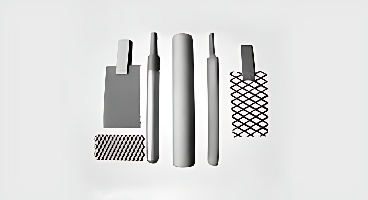
Substrate form follows the electrode type — plate and sheet for flat anodes, tube for MMO tubular anodes, wire for linear anodes; the titanium plate and sheet range covers the flat substrates.
A substrate problem never shows up on the day of delivery. It shows up as coating loss in patches, at 40 % of expected life, with the titanium underneath looking clean and grey.
Factor 3 — Electrolyte chemistry: three excluded species
The source specification for coated titanium anodes excludes three ions outright. This is not a "reduce where possible" recommendation; it is a compatibility boundary.
| Species | What it does to the anode | Practical position |
|---|---|---|
| Fluoride, F⁻ | Attacks titanium and the TiO₂ passive film directly; penetrates coating defects and dissolves substrate from beneath | Exclude. Where fluoride is inherent to the stream, the electrode system must be changed, not the coating loading |
| Cyanide, CN⁻ | Strong complexing agent; strips and poisons the catalyst surface | Exclude. Pre-treat before the electrochemical step |
| Sulphide, S²⁻ | Forms sulfide films that block active sites and depolarise the electrode | Exclude. Sulphide-bearing effluent needs oxidation upstream |
| Chloride, Cl⁻ | Not excluded — it is the working ion in electrochlorination | Acceptable and often required; check coating family against chloride level and pH — see Ru–Ir electrodes for seawater electrochlorination |
| Ca²⁺ / Mg²⁺ (hardness) | Scales the active surface, raising cell voltage | Manageable — but see Factor 4 before reaching for polarity reversal |
| Organics, oil, grease | Blind the active sites chemically | Pre-treatment: the cheapest life extension in the plant |
The pattern worth remembering: the species that kill an anode are the ones that either dissolve titanium (F⁻) or immobilise the catalyst (CN⁻, S²⁻, oil). Chloride, which frightens people, is usually the least of the problems.
Factor 4 — Polarity reversal
Reversing polarity is a recognised field technique for stripping scale from an electrode, and it works. It is also the fastest way to destroy a coating.
Mechanism. A mixed-metal-oxide coating is thermodynamically stable as an anode. Force the electrode cathodic and the surface chemistry inverts: hydrogen evolves on it, titanium hydride forms at the substrate interface, and the oxide layer loses adhesion and spalls. A few minutes of reversal can remove scale and a measurable fraction of coating at the same time.
Practical position. Use it as a last resort, at low current, for a short and defined duration, followed by controlled repassivation at low anodic current. Never as scheduled maintenance, and never on anodes whose remaining life you cannot afford to lose.
If reversal has become part of your routine, the real problem is upstream: hardness, supersaturation or an operating pH that guarantees scaling. Fix the water, not the electrode.
Factor 5 — Power interruptions
An anode that is switched off is not resting. It is sitting in an aggressive electrolyte at open-circuit potential, where the coating is less stable and residual oxidants keep working on it.
Three situations cause most of the damage:
- Long outages with electrolyte left in the cell. Chlorine or hypochlorite in the solution continues to attack the coating and the substrate at defects, without the anodic protection that normally keeps the surface passivated.
- Repeated short cycling. Soft-start and stop sequences that pass through partial polarisation produce a disproportionate number of low-current transitions, each one a small episode of the mechanism in Factor 4.
- Energising a dry or partly filled cell. Current with insufficient electrolyte means no heat removal and no ionic path — the fastest way to destroy an electrode in a single afternoon.
Countermeasures: flush and drain, or refill with low-chloride water on shutdown; avoid unnecessary stop-start; use a soft-start ramp; interlock the rectifier to a low-level sensor.
Factor 6 — Mechanical damage
Coating damage is not a cosmetic issue, because the failure mode is electrochemical rather than physical.
At a scratch, the exposed titanium becomes a small anode facing a large cathode of intact coating. The current that would have spread over a whole electrode concentrates into a fraction of a square millimetre: local current density rises by orders of magnitude, the substrate dissolves or passivates, and the coating around the defect undercuts and lifts. Failure is local and sudden, not gradual.
Handling rules that actually prevent this:
- Store in original packaging, dry, never stacked face-to-face.
- No wire brushing, sanding, grinding or abrasive pads — ever.
- No touch-up paint. A painted defect is an insulated defect plus a hidden corrosion cell.
- Gloves during installation; inspect and photograph every electrode before it goes in.
- Deburr and radius edges and welds on frames and baskets that electrodes slide against.
Four more factors that decide life in practice
The six above come from the field. Four others decide outcomes just as reliably:
- Temperature. Coating consumption rises with temperature, and hot effluent also changes which reaction dominates. Life data measured at ambient does not transfer to a 70 °C stream.
- Coating family versus duty. Ruthenium-based coatings are built for chlorine evolution; iridium-based for oxygen evolution; Ir–Ta for mixed duty; lead dioxide where the highest oxygen overpotential is needed — see the lead dioxide coated titanium anode range. Putting a chlorine-duty coating into an oxygen-evolution duty is the single most common cause of "the anode only lasted a year" — see where ruthenium-iridium and noble metal oxide anodes actually work.
- Current distribution and geometry. Anode-to-cathode spacing, edge effects, shielding by sludge or by the tank wall, and uneven flow all create local hot spots that fail first. A well-coated anode in a badly designed cell has a short life — which is why compact cells are built around a geometry, not just an electrode (see the tubular electrolyser for electrochemical wastewater treatment).
- Storage and commissioning. Dry storage, low-current commissioning and a documented first-week current check prevent most infant failures.
Diagnostic table: symptom to cause
| What you see | Most likely cause | What to do |
|---|---|---|
| Coating loss only at edges and near welds | Edge effect / local overcurrent | Radius edges; review spacing and shielding |
| Uniform thinning, life ≈ 50 % of claim | Operating current density above rating | Recalculate from wetted area; derate to the coating's rating |
| Grey titanium exposed in patches, coating gone cleanly | Substrate passivation or poor adhesion | Audit grade, certificate and surface preparation |
| Blistering, then spalling | Cathodic excursion, polarity reversal or cycling | Remove reversal from maintenance; check rectifier polarity |
| White or yellow crust, rising cell voltage | Hardness scaling | Water softening or controlled cleaning; do not reverse by default |
| Pitting under a scratch or dent | Handling damage at installation | Handling SOP, incoming inspection |
| Sudden failure after a shutdown | Open circuit with electrolyte left in cell | Flush/drain procedure, interlocked rectifier |
| One cell in a stack failing early | Uneven current distribution | Check cell voltages individually, not the stack total |
How to specify life so that it can be verified
The reason anode life arguments are endless is that the claims are unfalsifiable. Make them falsifiable:
- Coating loading in g/m², not "thick coating".
- Accelerated-life test result with duration and conditions — NACE TM0108 practice, batch-referenced.
- Rated current density, and the life at that current density — one number is meaningless without the other.
- Substrate grade, certificate and heat number.
- Coating system named by duty (chlorine evolution, oxygen evolution, mixed), not by trade name.
- Warranty expressed as a condition: "X years at ≤ Y A/m² in Z ppm chloride", which can be checked against your cell.
Xi'an AUE Technology has manufactured electrocatalytic titanium anodes for 21 years from a 20,000 m² facility under ISO 9001, with MMO anodes batch-verified by accelerated-life testing before shipment. If you send us the duty — electrolyte composition, current density, temperature and required life — we will tell you which coating family fits and what life to expect, and put the number in writing. Start from the electrochemical oxidation electrode range or the water treatment electrode overview. Typical duties we quote against: ammonia removal, landfill leachate and degradation and decolourisation. If you are new to DSAs, read the complete guide to coated titanium electrodes first.
FAQ
What is the single biggest factor in titanium anode service life? Current density, because it is the term you control continuously and because coating consumption accelerates with it. Substrate and electrolyte set the ceiling; current density decides how fast you reach it.
Does doubling the current density halve the life? No — it is worse than half. The 1/i1/i term alone would halve it, but the coating consumption rate also rises with current density, and high potential promotes gas evolution that lifts the coating.
Can a coated titanium anode be used in fluoride-containing wastewater? Not with a standard MMO-on-titanium system. Fluoride attacks the titanium substrate through any coating defect, and no practical coating loading compensates for it. The stream needs pre-treatment or a different electrode system.
Is polarity reversal a legitimate way to clean an anode? It removes scale effectively, and it removes coating at the same time. Treat it as a one-off rescue at low current for a defined period, never as scheduled maintenance.
Why did my anode fail after a plant shutdown? Because with the current off, the electrode sat at open-circuit potential in an electrolyte that still contained chlorine or hypochlorite. Flush and drain, or refill with low-chloride water, before de-energising for long periods.
Can a scratched electrode be repaired? No. Coating cannot be restored in the field, and paint makes it worse by hiding the defect while leaving a corrosion cell underneath. Replace the electrode, or accept the shorter life with a documented inspection.
Grade 1 or Grade 2 titanium — which is better? Both are acceptable. Grade 1 gives higher purity and ductility, Grade 2 higher strength. The grade matters less than the certificate: verify it, and verify the heat number.
How do I compare two suppliers' life claims? Convert both to charge capacity at a stated current density. A claim that cannot survive that conversion is a marketing number.
Bottom line
Anode life is not a property you buy; it is a budget you spend. Coating loading sets the budget, substrate quality decides whether it can be spent at all, electrolyte chemistry sets the price, and current density — together with reversal, outages and handling — decides the burn rate. Get the first three right at specification and the last four right in operation, and the years take care of themselves.
Send us your duty point and we will size the electrode against it: talk to an AUE engineer.
References and standards basis
- NACE/AMPP TM0108 — Testing of Catalyzed Titanium Anodes for Use in Soils or Natural Waters; the accelerated-life method behind charge-capacity figures.
- ASTM B338 — seamless and welded titanium tube, Grade 1 / Grade 2, the substrate specification used for tubular anodes.
- ASTM B265 — titanium strip, sheet and plate, the usual substrate specification for plate and mesh anodes.
- Product data: AUE coating systems (Ru–Ir, Ir–Ta, IrO₂, PbO₂ on Grade 1/2 titanium), batch accelerated-life testing, and rated current densities quoted per duty.
- Failure-mechanism statements (fluoride attack on titanium, hydride formation under cathodic polarisation, localised attack at coating defects) reflect standard electrochemical practice for coated titanium anodes.
Written by the technical team at Xi'an AUE Technology Co., Ltd. — manufacturer of electrocatalytic titanium anodes for water treatment, electrochlorination, electrowinning, electroplating and cathodic protection since 2005.