

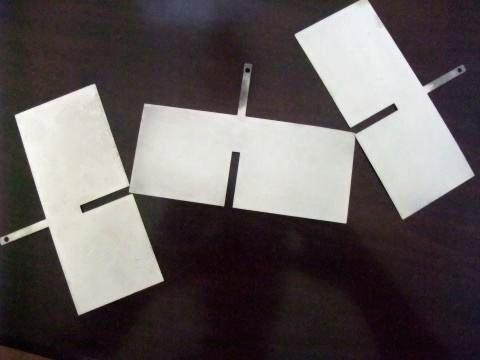
Platinized Titanium Anodes: Platinum-Coated Mesh, Plate and Rod in Industrial Electrolysis
Short answer: a platinized titanium anode is a titanium substrate carrying a pure platinum layer, typically 0.3–15 µm thick — which, at platinum's density, is 6.4–322 g/m² of platinum per square metre of coated surface. It exists because solid platinum is the only material that holds up to anodic oxygen evolution in acid, and because a micron of platinum on titanium delivers the same surface chemistry at a small fraction of the metal cost. This article sets out the eight-step plating process, reads the published specification line by line, and maps platinized mesh, plate, rod and wire to the duties they actually suit.
Specification at a glance
| Parameter | Value |
|---|---|
| Substrate | Titanium Grade 1, Grade 2, TA1 or TA2 |
| Forms | Mesh, plate, sheet, tube, rod, wire — or made to drawing |
| Coating | Platinum, 99.99% purity |
| Platinum loading | ≥ 21.48 g/m² (equal to 1 µm of platinum) |
| Platinum thickness | 0.3–15 µm (6.4–322 g/m²) |
| Current density | < 8,000 A/m² (80 mA/cm²) |
| Temperature | < 80 °C |
| pH | 1–12 |
| Process | Electroplating (brush plating) onto an activated titanium surface |
Why platinum, and why on titanium
Platinum is used as an anode because of two properties that rarely occur together: it resists oxidation while sitting at a potential where oxygen is being generated, and it catalyses that oxygen evolution at a low overpotential. In acid, few materials survive the first condition at all. That is why platinum anodes have been the standard in peroxodisulfate and hydrogen peroxide production, perchlorate and chlorate cells, and in plating baths where a contaminated anode destroys the deposit.
Solid platinum is also scarce, expensive and soft. A solid platinum plate thick enough to be handled is orders of magnitude more metal than the reaction needs, because the electrochemical reaction only happens at the surface. Platinized titanium inverts the arrangement: a titanium substrate provides the mechanical strength, the current distribution and the dimensional stability, and a micrometre-scale platinum layer provides the surface chemistry.
The substrate is not passive scaffolding. Titanium in an anodic cell forms a thin, coherent oxide film that protects the metal beneath — the same passivation that makes titanium useless as an anode without a coating is what keeps it intact underneath one. The coating supplies the electroactivity; the substrate makes the electrode affordable and rigid. The same logic is set out in the complete guide to coated titanium electrodes.
How a platinized titanium anode is made
The published process route has eight steps, and the order is not arbitrary. Steps 1 to 5 create the surface that platinum will bond to; steps 6 to 8 deposit and finish the layer. Adhesion failures are almost always decided in the first five.
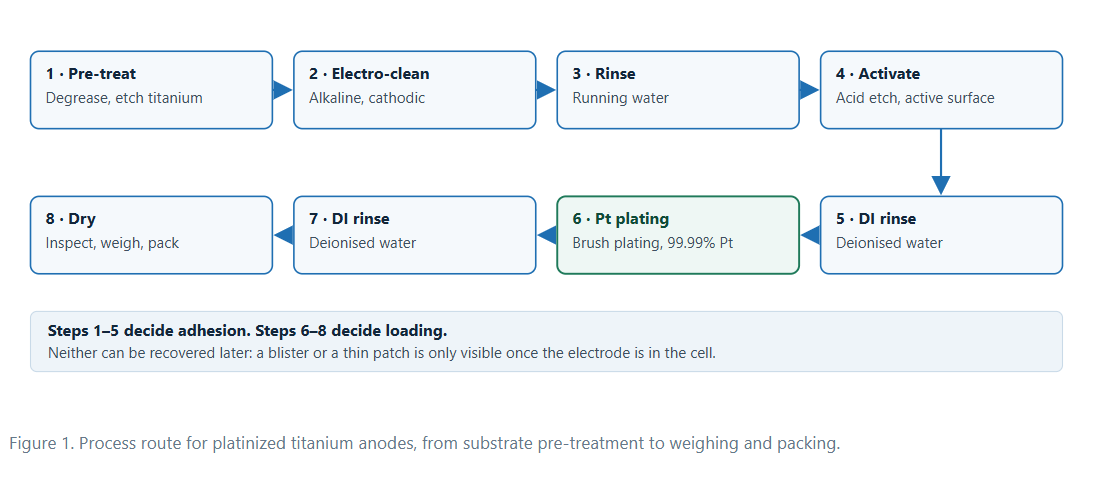
Figure 1. Process route for platinized titanium anodes, from substrate pre-treatment to weighing and packing.
Two details matter more than the list itself. First, the activation step is what converts passive titanium into a surface platinum can bond to — skip it and the coating survives handling but fails in service. Second, platinum is applied by brush plating rather than by immersion in most production, because it allows local repair, controlled deposit thickness and plating of large or awkward shapes without a tank sized to the workpiece.
The specification, read line by line
A specification is only useful if each number is tied to a consequence. These are the parameters that decide whether a platinized anode performs, and what happens when each is exceeded.
| Parameter | Published range | What it controls | Beyond the limit |
|---|---|---|---|
| Platinum thickness | 0.3–15 µm | Charge capacity, and therefore service life at a given current density | Below 0.3 µm, pores and substrate exposure dominate; thick deposits raise cost and internal stress |
| Platinum loading | ≥ 21.48 g/m² | The measurable, auditable form of thickness | A quotation in micrometres without loading cannot be compared between suppliers |
| Current density | < 8,000 A/m² | Reaction rate and platinum consumption per hour | Life falls faster than output rises; edge and gas-blanket effects accelerate coating loss |
| Temperature | < 80 °C | Platinum dissolution rate and substrate oxidation | Above 80 °C, platinum loss and titanium oxide growth both accelerate; the electrode is outside its design basis |
| pH | 1–12 | Substrate stability, not platinum stability | Strongly alkaline or fluoride-bearing electrolytes attack the titanium beneath a sound coating |
| Substrate grade | Gr1, Gr2, TA1, TA2 | Purity, corrosion allowance and formability | Lower-grade or contaminated titanium produces adhesion failures that look like plating faults |
Thickness and loading are the same number
Platinum has a density of 21.45 g/cm³, and one square metre of coating one micrometre thick is exactly one cubic centimetre of metal. So 1 µm of platinum on 1 m² weighs 21.45 g. That single identity reconciles the two numbers that suppliers quote interchangeably — and explains why a “minimum loading” of 21.48 g/m² is the same statement as “at least one micrometre”.
| Platinum thickness | Platinum loading (g/m²) | Typical use |
|---|---|---|
| 0.3 µm | ~6.4 | Short-life or low-current duty, laboratory cells, sensors |
| 1.0 µm | ~21.5 | The standard minimum for continuous industrial duty |
| 2.5 µm | ~53.6 | Water ionizers, chlorate cells, moderate current density |
| 5 µm | ~107 | Hard chrome plating, higher current density or longer design life |
| 10 µm | ~215 | Demanding acid duty where replacement downtime dominates cost |
| 15 µm | ~322 | Upper end of the range; thick deposits need stress control |
Because thickness and loading are proportional, a specification that gives only one of them is still workable — but the audit trail should show which was measured. Coating weight by mass difference is the usual production check; cross-section microscopy is the check for disputes.
Where platinized anodes are used
The common thread is anodic oxygen evolution in an acidic or halide-sensitive electrolyte, at a current density where a thin platinum layer is economic. These are the duties covered by the range:
| Application | Anodic reaction | Why platinized titanium | Usual form |
|---|---|---|---|
| Peroxodisulfate and hydrogen peroxide production | Oxidation of sulfate to peroxodisulfate | High anodic potential in strong acid; platinum is one of the few materials that survives it | Plate, sheet |
| Electrogalvanizing and electro-tinning of steel strip | Oxygen evolution in sulfate electrolyte | Dimensionally stable at high line speed; no sludge, no anode consumption | Plate, sheet |
| Electrolyzed and ionized water | Oxygen and chlorine evolution in potable water | Platinum is inert and does not introduce ruthenium or iridium into drinking water | Plate, mesh |
| Chlorate and hypochlorite cells | Chlorine evolution, with oxygen side reaction | Tolerates hypochlorite and chromate-free brine chemistry; simple to re-plate | Mesh, plate |
| Electroplating, particularly hard chrome | Oxygen evolution in chromic acid | No ruthenium contamination of the bath; stable potential gives predictable deposit thickness | Plate, rod, mesh |
| Cathodic protection | Oxygen or chlorine evolution depending on electrolyte | Low consumption rate in impressed-current systems with compact anodes | Rod, wire, probe |
| Electrodialysis and desalination | Chlorine and oxygen evolution in brine or brackish water | Stable in alternating polarity duty when the reverse cycle is controlled | Mesh, plate |
| Organic electrosynthesis | Oxidation of the organic substrate | High oxygen overpotential and chemical inertness avoid side reactions | Plate, mesh |
| Descaling and sterilisation cells | Chlorine or mixed oxidants | Compact electrode for intermittent duty; tolerant of start-stop operation | Rod, mesh |
Forms are not interchangeable. Mesh gives a high surface area per unit of projected area and is used where the cell is area-limited; plate gives uniform current distribution for flat work; rod and wire suit tubular cells, probes and compact assemblies. The full range is listed under platinized titanium electrodes, with the application-specific versions in platinum-plated anodes for hard chrome plating, platinum titanium plates for water ionizers, platinum-plated mesh for hydrogen production and platinum-coated anode wire.
Platinum, mixed metal oxide or lead dioxide
Platinized titanium is one of four coating families, and choosing it where another belongs is the most common specification error. The comparison below is about duty, not prestige.
| Coating | Best at | Weakness | Choose instead when |
|---|---|---|---|
| Platinum (0.3–15 µm) | Oxygen evolution in acid; low overpotential; inertness where bath or product contamination matters | Thin layer, limited charge capacity, destroyed by reverse current | High current density and long life are both required |
| Ir-Ta mixed metal oxide | Oxygen evolution at industrial current density over years | Higher initial cost; lower activity than platinum in some chloride duties | The duty is continuous oxygen evolution and capital cost is secondary |
| Ru-Ir mixed metal oxide | Chlorine evolution: seawater, hypochlorite, chlor-alkali | Ruthenium dissolves under oxygen-evolution duty | The anode is a chlorine-producing electrode |
| Lead dioxide | Highest oxygen overpotential; refractory organic oxidation | Contains lead; restricted for product-contact and discharge | No lead is permitted in the process |
The trade-off between a platinum layer and a mixed metal oxide is worked through in the MMO versus traditional anode selection guide; the arithmetic that converts loading into years is in what determines the service life of a titanium anode.
Five ways a platinized anode fails, and how each is avoided
- Reverse current. Driving a platinized electrode cathodic destroys the bond and can form titanium hydride under the coating. In polarity-reversal or intermittent cells, this is the dominant failure mode — the control is a sequence that never makes the anode negative, or a different coating chemistry.
- Running above the current density limit. Platinum consumption rises with charge passed, so life falls as current density rises. An anode sized at 8,000 A/m² and run there has a shorter life than the same anode run at half of it.
- Edge and contact attack. Coating is thinnest and current density highest at edges, weld zones and contact points. Good design rounds or masks edges and keeps the electrical contact out of the electrolyte.
- Substrate corrosion under a sound coating. At pH outside 1–12, or in fluoride-bearing electrolytes, the titanium beneath the platinum can corrode even though the coating looks intact. The symptom is blistering or a voltage rise with no visible coating loss.
- Mechanical damage in handling. A micrometre of platinum is not abrasion resistant. Mesh and thin sheet are damaged by grinding, scraping or stacking; packing and installation practice matter more than most buyers expect.
What to send for a quotation
Platinized anodes are made to drawing, so the enquiry determines both the answer and the price. Six inputs are enough to specify one:
- Geometry: drawing or dimensions, and the form (mesh, plate, rod, wire, tube) that fits the cell
- Electrolyte: composition, chloride or fluoride content, pH
- Operating temperature and whether it is continuous or cyclic
- Current density and total current per electrode
- Target service life, and whether the constraint is maintenance access or cost per year
- Polarity practice: whether the electrode is ever reversed, and how often the cell is shut down
With those, thickness and loading can be selected rather than guessed, and the life basis can be stated with the number behind it. Manufacturing and release testing are described in the quality control system, and the plating line is one of the stops on the factory tour.
Frequently asked questions
Can a platinized titanium anode be used as a cathode?
No. Under cathodic polarisation the coating bond is destroyed and titanium hydride can form beneath it. If a cell reverses polarity for cleaning or scale control, the cycle has to be designed around the anode — or a different electrode specified.
How long does a platinized anode last?
Life is set by platinum loading, current density and electrolyte. At 1 µm of platinum and a moderate current density in acid, industrial anodes are typically specified in years; at the top of the current-density range, in months. The defensible calculation is capacity in ampere-hours per square metre divided by charge passed per year — see the service life formula.
Why is the temperature limit 80 °C?
Above that, platinum dissolution and titanium oxide growth both accelerate, and the coating's service life falls faster than the temperature rise alone would suggest. The limit is a design envelope for the coating system, not a property of platinum metal.
Why is the pH range 1–12 rather than “acid only”?
Because the constraint is the titanium substrate, not the platinum. Strongly alkaline electrolytes and fluoride-bearing solutions attack titanium, particularly at coating defects, so a sound-looking coating can hide a corroding substrate.
Can the coating be repaired or re-plated?
Local repair by brush plating is practical, and a stripped substrate within tolerance can be re-plated at the specified loading. Both routes require the substrate to be assessed first — a hydrided or deeply pitted substrate should be replaced rather than re-coated.
Is platinized titanium suitable for drinking-water electrolysis?
It is the usual choice for ionized-water cells because platinum introduces no ruthenium or iridium into the water. Final acceptance depends on the applicable drinking-water contact regulations in your market, which should be checked against the complete wetted bill of materials, not the anode alone.
Discuss a platinized anode specification
Xi'an AUE Technology Co., Ltd.
Office: 19th Floor, Building 4, Taihua Jinmao International, High-tech Zone, Xi'an, Shaanxi, China
Factory: No. 1688 Hanhui Avenue, Qinhan New City, Xixian New Area, Shaanxi, China
Email: Bart@anodeae.com · Phone: +86 188 2169 2388
Send the drawing and the process data through the contact form, and the reply will state the platinum thickness, the loading behind it and the life basis at your current density. Company capability is summarised on the profile page, and general specification questions are answered in the titanium anode FAQ.
Xi'an AUE Technology · Published 11 November 2026 · Technical article
Short answer: a platinized titanium anode is a titanium substrate carrying a pure platinum layer, typically 0.3–15 µm thick — which, at platinum's density, is 6.4–322 g/m² of platinum per square metre of coated surface. It exists because solid platinum is the only material that holds up to anodic oxygen evolution in acid, and because a micron of platinum on titanium delivers the same surface chemistry at a small fraction of the metal cost. This article sets out the eight-step plating process, reads the published specification line by line, and maps platinized mesh, plate, rod and wire to the duties they actually suit.
Specification at a glance
| Parameter | Value |
|---|---|
| Substrate | Titanium Grade 1, Grade 2, TA1 or TA2 |
| Forms | Mesh, plate, sheet, tube, rod, wire — or made to drawing |
| Coating | Platinum, 99.99% purity |
| Platinum loading | ≥ 21.48 g/m² (equal to 1 µm of platinum) |
| Platinum thickness | 0.3–15 µm (6.4–322 g/m²) |
| Current density | < 8,000 A/m² (80 mA/cm²) |
| Temperature | < 80 °C |
| pH | 1–12 |
| Process | Electroplating (brush plating) onto an activated titanium surface |
Why platinum, and why on titanium
Platinum is used as an anode because of two properties that rarely occur together: it resists oxidation while sitting at a potential where oxygen is being generated, and it catalyses that oxygen evolution at a low overpotential. In acid, few materials survive the first condition at all. That is why platinum anodes have been the standard in peroxodisulfate and hydrogen peroxide production, perchlorate and chlorate cells, and in plating baths where a contaminated anode destroys the deposit.
Solid platinum is also scarce, expensive and soft. A solid platinum plate thick enough to be handled is orders of magnitude more metal than the reaction needs, because the electrochemical reaction only happens at the surface. Platinized titanium inverts the arrangement: a titanium substrate provides the mechanical strength, the current distribution and the dimensional stability, and a micrometre-scale platinum layer provides the surface chemistry.
The substrate is not passive scaffolding. Titanium in an anodic cell forms a thin, coherent oxide film that protects the metal beneath — the same passivation that makes titanium useless as an anode without a coating is what keeps it intact underneath one. The coating supplies the electroactivity; the substrate makes the electrode affordable and rigid. The same logic is set out in the complete guide to coated titanium electrodes.
How a platinized titanium anode is made
The published process route has eight steps, and the order is not arbitrary. Steps 1 to 5 create the surface that platinum will bond to; steps 6 to 8 deposit and finish the layer. Adhesion failures are almost always decided in the first five.
Figure 1. Process route for platinized titanium anodes, from substrate pre-treatment to weighing and packing.
Two details matter more than the list itself. First, the activation step is what converts passive titanium into a surface platinum can bond to — skip it and the coating survives handling but fails in service. Second, platinum is applied by brush plating rather than by immersion in most production, because it allows local repair, controlled deposit thickness and plating of large or awkward shapes without a tank sized to the workpiece.
The specification, read line by line
A specification is only useful if each number is tied to a consequence. These are the parameters that decide whether a platinized anode performs, and what happens when each is exceeded.
| Parameter | Published range | What it controls | Beyond the limit |
|---|---|---|---|
| Platinum thickness | 0.3–15 µm | Charge capacity, and therefore service life at a given current density | Below 0.3 µm, pores and substrate exposure dominate; thick deposits raise cost and internal stress |
| Platinum loading | ≥ 21.48 g/m² | The measurable, auditable form of thickness | A quotation in micrometres without loading cannot be compared between suppliers |
| Current density | < 8,000 A/m² | Reaction rate and platinum consumption per hour | Life falls faster than output rises; edge and gas-blanket effects accelerate coating loss |
| Temperature | < 80 °C | Platinum dissolution rate and substrate oxidation | Above 80 °C, platinum loss and titanium oxide growth both accelerate; the electrode is outside its design basis |
| pH | 1–12 | Substrate stability, not platinum stability | Strongly alkaline or fluoride-bearing electrolytes attack the titanium beneath a sound coating |
| Substrate grade | Gr1, Gr2, TA1, TA2 | Purity, corrosion allowance and formability | Lower-grade or contaminated titanium produces adhesion failures that look like plating faults |
Thickness and loading are the same number
Platinum has a density of 21.45 g/cm³, and one square metre of coating one micrometre thick is exactly one cubic centimetre of metal. So 1 µm of platinum on 1 m² weighs 21.45 g. That single identity reconciles the two numbers that suppliers quote interchangeably — and explains why a “minimum loading” of 21.48 g/m² is the same statement as “at least one micrometre”.
| Platinum thickness | Platinum loading (g/m²) | Typical use |
|---|---|---|
| 0.3 µm | ~6.4 | Short-life or low-current duty, laboratory cells, sensors |
| 1.0 µm | ~21.5 | The standard minimum for continuous industrial duty |
| 2.5 µm | ~53.6 | Water ionizers, chlorate cells, moderate current density |
| 5 µm | ~107 | Hard chrome plating, higher current density or longer design life |
| 10 µm | ~215 | Demanding acid duty where replacement downtime dominates cost |
| 15 µm | ~322 | Upper end of the range; thick deposits need stress control |
Because thickness and loading are proportional, a specification that gives only one of them is still workable — but the audit trail should show which was measured. Coating weight by mass difference is the usual production check; cross-section microscopy is the check for disputes.
Where platinized anodes are used
The common thread is anodic oxygen evolution in an acidic or halide-sensitive electrolyte, at a current density where a thin platinum layer is economic. These are the duties covered by the range:
| Application | Anodic reaction | Why platinized titanium | Usual form |
|---|---|---|---|
| Peroxodisulfate and hydrogen peroxide production | Oxidation of sulfate to peroxodisulfate | High anodic potential in strong acid; platinum is one of the few materials that survives it | Plate, sheet |
| Electrogalvanizing and electro-tinning of steel strip | Oxygen evolution in sulfate electrolyte | Dimensionally stable at high line speed; no sludge, no anode consumption | Plate, sheet |
| Electrolyzed and ionized water | Oxygen and chlorine evolution in potable water | Platinum is inert and does not introduce ruthenium or iridium into drinking water | Plate, mesh |
| Chlorate and hypochlorite cells | Chlorine evolution, with oxygen side reaction | Tolerates hypochlorite and chromate-free brine chemistry; simple to re-plate | Mesh, plate |
| Electroplating, particularly hard chrome | Oxygen evolution in chromic acid | No ruthenium contamination of the bath; stable potential gives predictable deposit thickness | Plate, rod, mesh |
| Cathodic protection | Oxygen or chlorine evolution depending on electrolyte | Low consumption rate in impressed-current systems with compact anodes | Rod, wire, probe |
| Electrodialysis and desalination | Chlorine and oxygen evolution in brine or brackish water | Stable in alternating polarity duty when the reverse cycle is controlled | Mesh, plate |
| Organic electrosynthesis | Oxidation of the organic substrate | High oxygen overpotential and chemical inertness avoid side reactions | Plate, mesh |
| Descaling and sterilisation cells | Chlorine or mixed oxidants | Compact electrode for intermittent duty; tolerant of start-stop operation | Rod, mesh |
Forms are not interchangeable. Mesh gives a high surface area per unit of projected area and is used where the cell is area-limited; plate gives uniform current distribution for flat work; rod and wire suit tubular cells, probes and compact assemblies. The full range is listed under platinized titanium electrodes, with the application-specific versions in platinum-plated anodes for hard chrome plating, platinum titanium plates for water ionizers, platinum-plated mesh for hydrogen production and platinum-coated anode wire.
Platinum, mixed metal oxide or lead dioxide
Platinized titanium is one of four coating families, and choosing it where another belongs is the most common specification error. The comparison below is about duty, not prestige.
| Coating | Best at | Weakness | Choose instead when |
|---|---|---|---|
| Platinum (0.3–15 µm) | Oxygen evolution in acid; low overpotential; inertness where bath or product contamination matters | Thin layer, limited charge capacity, destroyed by reverse current | High current density and long life are both required |
| Ir-Ta mixed metal oxide | Oxygen evolution at industrial current density over years | Higher initial cost; lower activity than platinum in some chloride duties | The duty is continuous oxygen evolution and capital cost is secondary |
| Ru-Ir mixed metal oxide | Chlorine evolution: seawater, hypochlorite, chlor-alkali | Ruthenium dissolves under oxygen-evolution duty | The anode is a chlorine-producing electrode |
| Lead dioxide | Highest oxygen overpotential; refractory organic oxidation | Contains lead; restricted for product-contact and discharge | No lead is permitted in the process |
The trade-off between a platinum layer and a mixed metal oxide is worked through in the MMO versus traditional anode selection guide; the arithmetic that converts loading into years is in what determines the service life of a titanium anode.
Five ways a platinized anode fails, and how each is avoided
- Reverse current. Driving a platinized electrode cathodic destroys the bond and can form titanium hydride under the coating. In polarity-reversal or intermittent cells, this is the dominant failure mode — the control is a sequence that never makes the anode negative, or a different coating chemistry.
- Running above the current density limit. Platinum consumption rises with charge passed, so life falls as current density rises. An anode sized at 8,000 A/m² and run there has a shorter life than the same anode run at half of it.
- Edge and contact attack. Coating is thinnest and current density highest at edges, weld zones and contact points. Good design rounds or masks edges and keeps the electrical contact out of the electrolyte.
- Substrate corrosion under a sound coating. At pH outside 1–12, or in fluoride-bearing electrolytes, the titanium beneath the platinum can corrode even though the coating looks intact. The symptom is blistering or a voltage rise with no visible coating loss.
- Mechanical damage in handling. A micrometre of platinum is not abrasion resistant. Mesh and thin sheet are damaged by grinding, scraping or stacking; packing and installation practice matter more than most buyers expect.
What to send for a quotation
Platinized anodes are made to drawing, so the enquiry determines both the answer and the price. Six inputs are enough to specify one:
- Geometry: drawing or dimensions, and the form (mesh, plate, rod, wire, tube) that fits the cell
- Electrolyte: composition, chloride or fluoride content, pH
- Operating temperature and whether it is continuous or cyclic
- Current density and total current per electrode
- Target service life, and whether the constraint is maintenance access or cost per year
- Polarity practice: whether the electrode is ever reversed, and how often the cell is shut down
With those, thickness and loading can be selected rather than guessed, and the life basis can be stated with the number behind it. Manufacturing and release testing are described in the quality control system, and the plating line is one of the stops on the factory tour.
Frequently asked questions
Can a platinized titanium anode be used as a cathode?
No. Under cathodic polarisation the coating bond is destroyed and titanium hydride can form beneath it. If a cell reverses polarity for cleaning or scale control, the cycle has to be designed around the anode — or a different electrode specified.
How long does a platinized anode last?
Life is set by platinum loading, current density and electrolyte. At 1 µm of platinum and a moderate current density in acid, industrial anodes are typically specified in years; at the top of the current-density range, in months. The defensible calculation is capacity in ampere-hours per square metre divided by charge passed per year — see the service life formula.
Why is the temperature limit 80 °C?
Above that, platinum dissolution and titanium oxide growth both accelerate, and the coating's service life falls faster than the temperature rise alone would suggest. The limit is a design envelope for the coating system, not a property of platinum metal.
Why is the pH range 1–12 rather than “acid only”?
Because the constraint is the titanium substrate, not the platinum. Strongly alkaline electrolytes and fluoride-bearing solutions attack titanium, particularly at coating defects, so a sound-looking coating can hide a corroding substrate.
Can the coating be repaired or re-plated?
Local repair by brush plating is practical, and a stripped substrate within tolerance can be re-plated at the specified loading. Both routes require the substrate to be assessed first — a hydrided or deeply pitted substrate should be replaced rather than re-coated.
Is platinized titanium suitable for drinking-water electrolysis?
It is the usual choice for ionized-water cells because platinum introduces no ruthenium or iridium into the water. Final acceptance depends on the applicable drinking-water contact regulations in your market, which should be checked against the complete wetted bill of materials, not the anode alone.
Discuss a platinized anode specification
Xi'an AUE Technology Co., Ltd.
Office: 19th Floor, Building 4, Taihua Jinmao International, High-tech Zone, Xi'an, Shaanxi, China
Factory: No. 1688 Hanhui Avenue, Qinhan New City, Xixian New Area, Shaanxi, China
Email: Bart@anodeae.com ·WhatsApp : +86 188 2169 2388
Send the drawing and the process data through the contact form, and the reply will state the platinum thickness, the loading behind it and the life basis at your current density. Company capability is summarised on the profile page, and general specification questions are answered in the titanium anode FAQ.